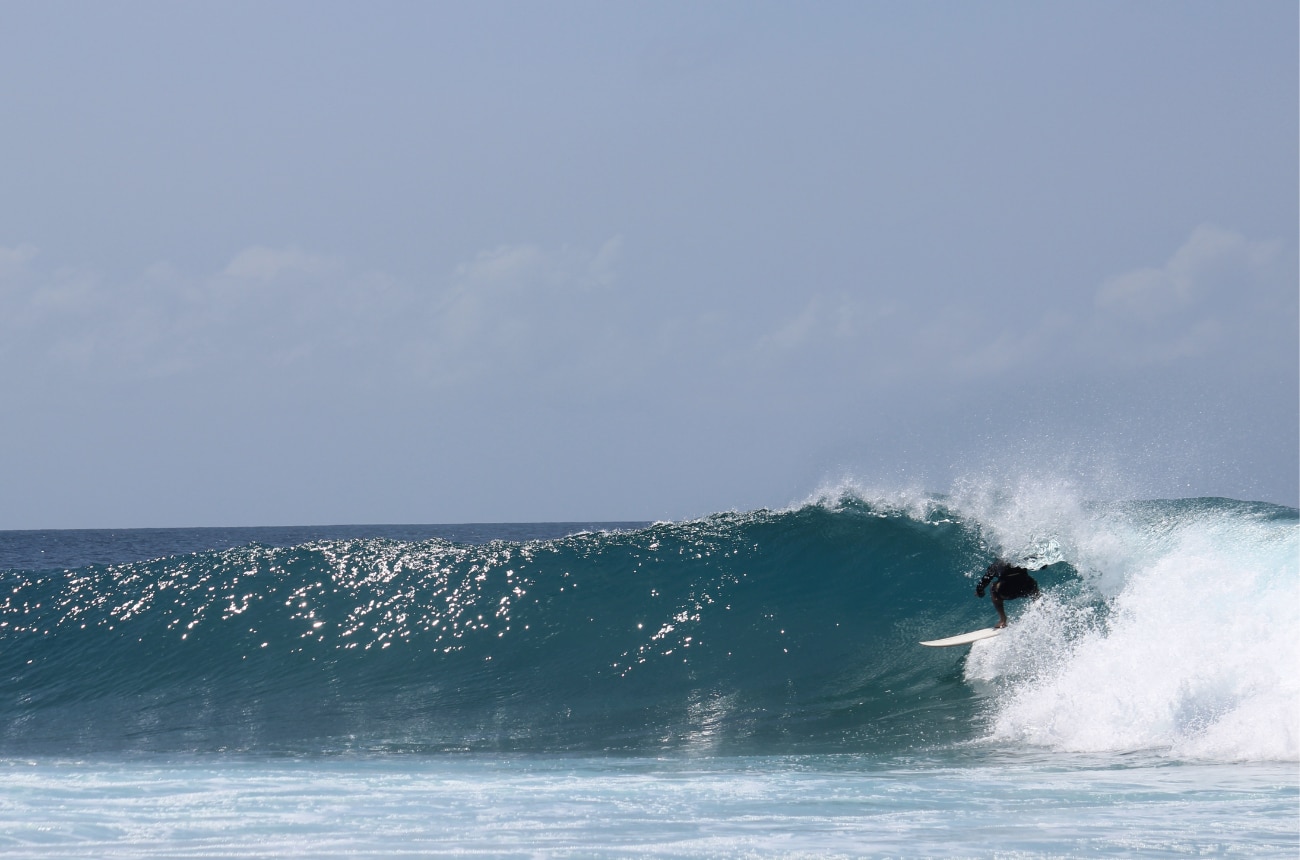

When you think about your next surf trip, you probably think about warm water, long sessions, fun times, like-minded people, new friends, the sun on your face… and sunscreen.
When we are heading on a surf trip, we know we will spend hours in nature, in the water, on the beach, and ultimately in the sun. So, we need sunscreen. We mostly just take products with us, without thinking twice. But the reality is: what we put on our skin does not stay there.
When we spend hours in the water, surfing, waiting for the next set, or yapping with new friends, a part of our sunscreen ends up in the water.
And spoiler alert: not all sunscreen belongs there.
The uncomfortable truth about “reef-safe“ sunscreen
We read terms like “reef-safe” and “reef-friendly” on numerous sunscreen packages.
The problem here is that it does not actually mean anything… There is no official definition of those terms, no global regulation, and no testing standard behind it. This means that many products labeled “reef-safe” still contain components that can harm coral and marine life.
What is even more shocking is that only a small part of the UV (ultraviolet) filters used worldwide have actually been tested for their impact on reefs.

What happens when sunscreen enters the ocean
When you paddle out, your sunscreen does not stay on your skin entirely.
- Up to 25% can wash off during a session
- Chemicals spread through the water and attach to marine life
- Some accumulate in fish, corals, and sediments
- Others break down into new compounds under sunlight that may even be more reactive or toxic
Certain filters can:
- Damage coral DNA
- Disrupt growth and reproduction
- Trigger bleaching
- Interfere with marine ecosystems on a larger scale
This means, sunscreen is not just disappearing from your body, it becomes part of the ocean.
Chemical vs. Mineral Sunscreens
For years, the rule seemed simple: avoid “chemical” sunscreens and use “mineral” ones. But in reality, it is a bit more complex.
Some chemical filters, with widely known issues include:
- Oxybenzone
- Octinoxate
- Octocrylene
These have been linked to coral bleaching and marine toxicity and are banned in places like Hawaii and Palau.
But mineral filters are not automatically less harmful for the environment… Zinc oxides in nano or uncoated form can also cause rapid coral stress and bleaching.
Mineral sunscreens need the right composition (non-nano or coated) to be less harmful to the environment. In this form, mineral filters are the better option, plus they are considered safer for your health.
Mineral sunscreens stay on the surface of your skin and do not enter your bloodstream, disrupt your hormones, or cause skin irritation such as chemical sunscreens do. For more information check out the Suntribe‘s blog entry.

What Surfers can do
First of all, we do not want to say that you should not use any sunscreen anymore. Please do! Sunscreen is important because it reduces sunburn, premature aging, and skin cancer. It is one of the best ways to protect your skin health over a lifetime.
But there are also other ways to reduce the impact sunscreen has on the environment…
Reduce the amount of sunscreen entering the water
When possible:
- Wear UPF (ultraviolet protection factor) clothing: Hats, and rash guards or surf t-shirts are perfect alternatives, the latter especially when you do not need a wetsuit
- Time your sessions: Surf early or late to avoid peak sun (this matches with many surf spots worldwide, where onshore winds often pick up around 11am)
- Search for shade between the sessions: You not only need less sunscreen, your body will also thank you for not being exposed to the sun all day

When you use sunscreen, choose it more carefully
Try to avoid the following components where possible:
- Oxybenzone
- Octinoxate
- Octocrylene
- Homosalate
- Octisalate
- Avobenzone
Be mindful of high-concentrated zinc oxide pastes in nano or uncoated form.
Look for:
- Formulations that are tested as a whole and are not just labeled
- Newer eco-assessed blends or coated mineral filters for example Non-Nano Zinc Dioxide or Titanium Dioxide since they are currently considered as the safest UV-filters regarding coral reef damage
- Brands that communicate transparently and show awareness rather than perfection
- Sustainability as a whole, so brands that also consider responsible packaging
This is why we partnered up with the Suntribe. Yes, funny enough the name is very similar to ours, but that is not the only cool thing about them. They focus on mineral-based formulas, minimal ingredients and use a lower-impact approach for surfers spending hours in the water. Plus, they are also aware of the buzz word problem of “reef-safe” sunscreen and define it for themselves.
Apply sunscreen mindfully
- Apply sunscreen away from the water and let it absorb properly
- If possible, wash the sunscreen off before entering sensitive reef areas
All these small habits make a difference when adopted by many and repeated over time. And yes, it is as simple as that: the less sunscreen in the water, the lower the impact.

Final Thoughts
Surfing is about connection with the ocean, with nature and with places that still feel untouched. We need and want to protect that. This does not mean being perfect but being aware.
So please, of course use sunscreen when needed, but think twice, choose better product options, include alternative habits, and understand the impact you have. Because often “reef-safe” does not mean what it says.
This is why we, together with Suntribe, want to make more conscious decisions about sunscreen easier… So every time you book a trip with The Surf Tribe, you will receive a discount code for their sunscreens and zinc!
Next time you paddle out, take a moment to think about what you are bringing into the water with you. Because the best waves are the ones we can keep coming back to.
Sunscreen is just part of the story. Learn more about What responsible surf travel looks like for The Surf Tribe
Sources:
Chatzigianni, M., Pavlou, P., Siamidi, A., Vlachou, M., Varvaresou, A., & Papageorgiou, S. (2022). Environmental impacts due to the use of sunscreen products: a mini-review. Ecotoxicology, 31(9), 1331–1345. https://doi.org/10.1007/s10646-022-02592-w
Miller, I. B., Pawlowski, S., Kellermann, M. Y., Petersen-Thiery, M., Moeller, M., Nietzer, S., & Schupp, P. J. (2021). Toxic effects of UV filters from sunscreens on coral reefs revisited: regulatory aspects for “reef safe” products. Environmental Sciences Europe, 33(1). https://doi.org/10.1186/s12302-021-00515-w
Raffa, R. B., Pergolizzi, J. V., Taylor, R., & Kitzen, J. M. (2018). Sunscreen bans: Coral reefs and skin cancer. Journal of Clinical Pharmacy and Therapeutics, 44(1), 134–139. https://doi.org/10.1111/jcpt.12778
Henderson, S., King, K., Karipidis, K., Tinker, R., & Green, A. (2022). Effectiveness, compliance and application of sunscreen for solar ultraviolet radiation protection in Australia. Public Health Research & Practice, 32(1). https://doi.org/10.17061/phrp3212205
Watkins, Y. S. D., & Sallach, J. B. (2021b). Investigating the exposure and impact of chemical UV filters on coral reef ecosystems: Review and research gap prioritization. Integrated Environmental Assessment and Management, 17(5), 967–981. https://doi.org/10.1002/ieam.4411
Blog entries from Suntribe and their homepage:
https://suntribesunscreen.com/en-es
https://suntribesunscreen.com/en-es/blogs/blog/reef-safe-definition-and-what-it-actually-means